


Views: 0 Author: Site Editor Publish Time: 2026-06-01 Origin: Site


Flux-cored arc welding demands absolute precision from the exact moment you plug your equipment into the wall. Even top-tier fabrication tools will fail immediately without the proper configuration. A flawless setup guarantees maximum structural integrity and high operational efficiency. However, improper flux-cored arc welding (FCAW) setup remains the leading cause of porosity, excessive spatter, and failed weld inspections. These recurring issues halt production lines and frustrate experienced operators. Setting up for flux-cored wire is not just a standard procedural step. Buyers must treat it as a critical evaluation criterion when purchasing equipment. You must carefully assess whether a specific unit allows for a seamless transition to FCAW, or if it requires costly aftermarket modifications. This guide details the exact mechanical and electrical requirements for flux-cored setup. We also provide a robust framework to evaluate equipment capabilities before making a massive capital investment.
Polarity is Non-Negotiable: Flux-cored welding requires a Direct Current Electrode Negative (DCEN) setup; machines without accessible polarity swaps introduce severe implementation friction.
Drive Mechanisms Matter: Standard smooth drive rolls will crush flux-cored wire; V-knurled rolls are a mandatory hardware requirement.
Tension Calibration Prevents Downtime: Setting drive tension specifically for tubular wire minimizes the risk of "bird-nesting" inside the machine.
Equipment Scalability: Buyers must weigh the low barrier to entry of dedicated gasless machines against the long-term ROI of multi-process units.
Operators must define strict success criteria before striking an arc. A successful FCAW setup demands specific mechanical traits. The unit must handle tubular wire without causing deformation. It must also output the correct electrical polarity reliably. Evaluating your hardware early prevents costly downstream failures.
Drive roll compatibility serves as your first major checkpoint. Solid wire uses smooth V-groove rolls. These rolls squeeze the wire tightly. Conversely, flux-cored wire is hollow and fragile. It requires V-knurled rolls. These toothed rolls grip the soft wire gently. They push it through the liner without crushing the internal flux powder.
Decision Factor: You must carefully check the factory inclusions. Does your welding machine come with V-knurled rolls directly out of the box? Missing rolls represent an immediate hidden cost and delay your project launch.
Contact tip and nozzle assessment requires equal attention. Flux-cored wire burns much hotter than standard solid wire. It expands significantly as it exits the gun. You should use a contact tip one size larger than your wire diameter. For example, pair a .035 tip with a .030 wire. Industry professionals use this standard risk mitigation tactic daily. It prevents the expanding wire from fusing to the copper tip, which causes frustrating burn-backs.
You must also evaluate the nozzle assembly. Remove the standard MIG gas nozzle. Install a dedicated flux-core specific nozzle instead. This simple swap protects your gas diffuser from flying spatter. It also dramatically improves your visual line of sight to the weld joint, allowing for tighter control over the puddle.
Best Practice: Inspect the drive roll teeth for wear before every major project to prevent erratic feeding.
Best Practice: Keep spare oversized contact tips in your mobile toolbox at all times.
Common Mistake: Running tubular wire through smooth U-groove aluminum rolls, which guarantees wire slippage.
Common Mistake: Leaving a wide MIG gas nozzle on the gun, which traps excessive slag and blocks your view.
Component | Solid Wire (MIG) Requirement | Flux-Cored Wire (FCAW) Requirement |
|---|---|---|
Drive Rolls | V-Groove (Smooth) | V-Knurled (Toothed) |
Contact Tip Size | Exact match to wire diameter | One size larger than wire diameter |
Nozzle Type | Standard gas nozzle (wide) | Flux-core specific nozzle (narrow/tapered) |
Electrical polarity determines where the arc heat concentrates during welding. Solid wire MIG welding utilizes DCEP. This stands for Direct Current Electrode Positive. It drives the heat into the base metal for deep penetration. Gasless flux-cored wire operates under a completely different electrical framework. It requires DCEN. This means Direct Current Electrode Negative. DCEN focuses the heat on the electrode itself. This intense heat effectively melts the internal flux core to generate shielding gas.
Operators must follow strict implementation steps to reverse polarity safely:
Turn off the main power source entirely and unplug the unit if possible.
Locate the internal or external polarity terminals.
Connect the ground clamp cable to the positive (+) terminal.
Connect the MIG gun lead to the negative (-) terminal.
Secure all connections tightly with a wrench to prevent voltage drops.
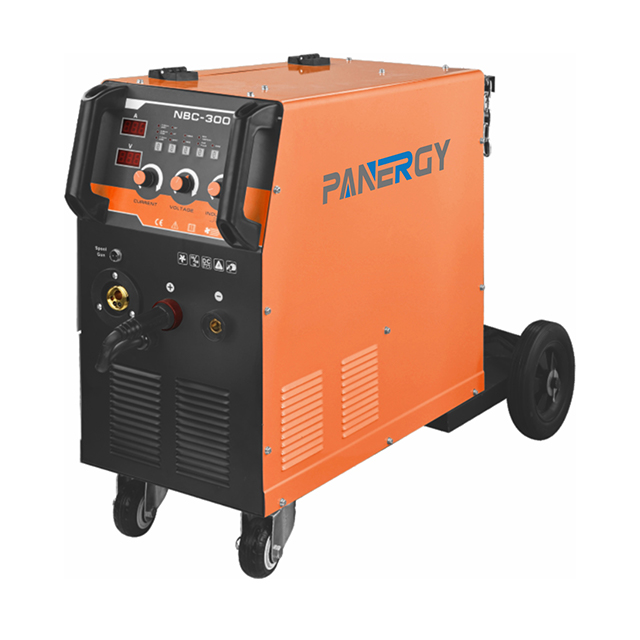
Evaluating machine design for polarity changes saves massive headaches. You should look for a low-friction setup. Premium units feature toolless, front-panel polarity swapping cables. You simply twist and swap the cables externally in seconds. Conversely, a high-friction setup slows down production. These units require internal terminal unbolting. You must use wrenches to manually swap ring terminals inside the cabinet. This design scales poorly. It heavily penalizes operators if frequent process changes are required between indoor and outdoor work.
You must actively manage wire tension risks during setup. Flux-cored wire features a delicate, hollow structure. It collapses easily under pressure. Excessive drive roll tension causes it to flatten immediately. Sometimes, the wire snaps completely. This leads to a severe "bird-nest" tangle inside the feeder mechanism. Clearing a bird-nest destroys productivity. It forces you to cut the ruined wire, clean the drive mechanism, and re-feed the spool from scratch.
Execute a specific setup action to find the perfect tension. First, back off the tension knob completely. Feed the wire and pinch it lightly at the gun nozzle. Tighten the knob slowly until the drive rolls just begin to slip. Finally, tighten it just a quarter-turn more. The wire should feed smoothly against light resistance. It should never deform.
Voltage and WFS calibration dictate your final weld profile. Voltage acts as the electrical pressure. It controls the arc length. It also determines the spread and flatness of your weld pool. Wire Feed Speed (WFS) acts differently. It directly dictates the machine amperage. WFS governs how deeply the arc penetrates the base metal.
Set strict evaluation criteria for machine interfaces. Look for units featuring synergic controls. These advanced systems automatically adjust voltage when you change WFS. Alternatively, seek highly accurate internal parameter charts. These charts must tailor settings specifically to FCAW. Generic MIG settings will fail when applied to tubular wire.
Different fabrication environments require entirely different equipment solutions. Buyers must evaluate these solution categories carefully to match operational demands.
Pros: They feature a very low initial cost. These units are highly portable for field repairs. Manufacturers pre-set them permanently to DCEN polarity. You simply plug them in and weld.
Cons: They offer zero scalability. You cannot upgrade them to solid wire MIG later. They lack internal gas solenoids for shielding gas processes.
Pros: They deliver high versatility for mixed environments. They allow you to run flux-cored wire outdoors in windy conditions. You can quickly switch them to solid wire and gas. This enables cleaner indoor fabrication on mild steel.
Strategic evaluation is critical here. Your future pipeline might include thin-gauge stainless steel. You might also plan for precision aluminum work. Investing solely in a flux-capable MIG machine will limit your operations. Upgrading to a comprehensive 3-in-1 unit solves this bottleneck. It prevents the need to buy a separate TIG welding machine later. This smart consolidation optimizes your shop floor space. It also maximizes your initial capital expenditure by providing three processes in one footprint.
Never weld on the final workpiece blindly. You must validate the setup before production begins. Run a preliminary test bead on scrap material. Ensure the scrap matches your production material in identical thickness. A proper setup yields very specific feedback. You will hear a crisp, consistent "bacon-frying" sound. The resulting weld will feature easily removable, crusty slag. The bead underneath will look smooth and uniform without excessive spatter.
Identifying implementation failures quickly keeps projects on schedule. Pay close attention to visual weld defects during your test runs.
Worm-tracking (marks in the weld): These are distinct grooves in the weld face. They usually indicate your voltage is too high for the current WFS. Lower the voltage slightly to eliminate them.
Severe Porosity (swiss cheese look): This defect almost always confirms your polarity is incorrect. Check that you are not still running on DCEP. Alternatively, the base metal might hold excessive moisture or rust. Severe contamination exceeds the flux's chemical deoxidizing limits.
Stubbing (wire pushing into the plate): This happens when the wire violently pushes into the plate. The arc sputters and struggles to stay lit. Your WFS is entirely too high relative to the voltage output. Reduce the wire speed to stabilize the arc.
Defect Symptom | Primary Cause | Immediate Correction |
|---|---|---|
Worm-Tracking | Voltage too high | Decrease voltage dial by 0.5V - 1V |
Porosity (Holes) | Wrong Polarity (DCEP) | Switch to DCEN configuration |
Stubbing / Popping | WFS too fast | Decrease Wire Feed Speed |
Bird-Nesting | Drive tension too tight | Loosen tension, use knurled rolls |
When evaluating equipment for flux-cored applications, apply strict shortlisting logic. Prioritize units that include knurled drive rolls directly in the box. Demand machinery that offers toolless, front-panel polarity reversal. Always check for clear, dedicated parameter charts for tubular wire on the cabinet door. These features dramatically reduce friction during process changes.
Take immediate action on your next steps. Review the exact spec sheets of your shortlisted machines. Confirm their out-of-the-box FCAW compatibility before purchasing. Finally, audit your current consumable inventory. Ensure you stock correctly sized contact tips and flux-core specific nozzles to guarantee uninterrupted fabrication.
A: Running on DCEP instead of DCEN will result in an erratic arc, excessive spatter, poor penetration, and highly porous welds that will fail structural inspection.
A: Not for standard self-shielded wire (FCAW-S). The flux inside the wire creates its own protective slag. However, dual-shield wire (FCAW-G) does require external gas, a distinction buyers must verify when purchasing wire.
A: No. TIG machines use a constant current (CC) power source and a non-consumable tungsten electrode. Flux-cored welding requires a constant voltage (CV) power source and a continuous wire feed mechanism. (Unless it is a specialized multi-process CC/CV machine with a wire feeder).
